Book a working session
Hazardous-materials compliance · SAP BTP or standalone

Know what’s in the asset
before the crew opens it.

HazardIQ turns a static asbestos & hazardous-materials register into a HOLD / CAUTION / CLEAR verdict at the moment work is about to happen — hung off your real asset hierarchy, on the platform you already run.

SAP CAP · XSUAA · HANAEsri-ready GeoJSONAligned to ISO 55001 · ISO 8000-8
WORK-ORDER SAFETY CHECKWO-48213 · EXCAVATION
HOLD
locationFL WTR-MAIN-SEG004 · AC pressure main
matchedAsbestos (bonded) · GOOD · confirmed buffer 50m
whyIntrusive job within controlled buffer of a registered ACM occurrence.
actionPermit-to-work + licensed controls before disturbance.
noteEvidence, not duty — the PCBU remains responsible for WHS compliance. Illustrative, synthetic data.
See it in 30 seconds

A work order, checked before the crew moves.

22 seconds, captioned. It starts only when you press play. Synthetic demo data.
The problem

Your biggest asbestos risk is buried, out of sight, and disturbed by routine work.

Asset owners carry vast legacy asbestos — AC pipe, lagging, sheeting, lead paint, silica. The register usually lives in spreadsheets and PDFs that nobody checks before the dig, the cut or the strip-out.

The register isn’t a control

A spreadsheet doesn’t flag a crew about to cut into an AC main. The hazard data has to reach the work order before work starts.

Waste & competency gaps

Asbestos waste must be tracked to a licensed facility, and removalists must hold current licences. Manual processes miss both.

No defensible record

When a claim lands years later you need a tamper-evident trail of who knew what, and when — not reconstructed paperwork.

How it works · the differentiator

“Dial before you dig” — the control a spreadsheet can’t give you.

Before any excavation, drill, cut or strip-out, HazardIQ answers one question: is it safe to work here? The verdict follows the job type, not just the material’s condition — a routine excavation over a sound asbestos-cement main still returns HOLD. It fails safe: CLEAR appears only where the area has a recorded survey. HazardIQ flags, gates and evidences; your people stay responsible.

How HazardIQ checks a work order, in four steps Step 1: a work order is raised in SAP S/4HANA PM, Maximo or TechnologyOne. Step 2: HazardIQ checks the register, the location and the job type. Step 3: the verdict is HOLD, CAUTION or CLEAR, with the controls that apply. Step 4: the check is logged as evidence and the crew is briefed. 1 Work order raised A work order is raised in SAP S/4HANA PM, Maximo or TechnologyOne. work orderWO-48213 job typeEXCAVATION locationWTR-MAIN-SEG004 SAP S/4HANA PM IBM Maximo TechnologyOne 2 HazardIQ checks It checks the register, the location and the job type. Registerhazards and condition LocationFL, equipment, lat/lon Job typehow intrusive the job is missing or low-confidence data never returns CLEAR 3 HOLD, CAUTION or CLEAR The verdict comes with the controls that apply. HOLDStop. Controls andpermit-to-work first CAUTIONAcknowledge, thenfollow the controls CLEARSurveyed area, noknown hazard the verdict follows the job type 4 Logged and briefed The check is logged as evidence and the crew is briefed. #1HOLD #2CAUTION #3CLEAR tamper-evident, hash-chained Crew safety brief hazards nearby,the controls,who is on call evidence, not duty

Illustrative flow with synthetic data. HazardIQ flags, gates and evidences; the duty-holder remains responsible for WHS compliance.

See the full product →

What your teams see

The product itself, one scenario: a water utility.

Screens captured from the demo instance. Every site, work order and figure is synthetic.

hazardiq · work-order safety check · demo data
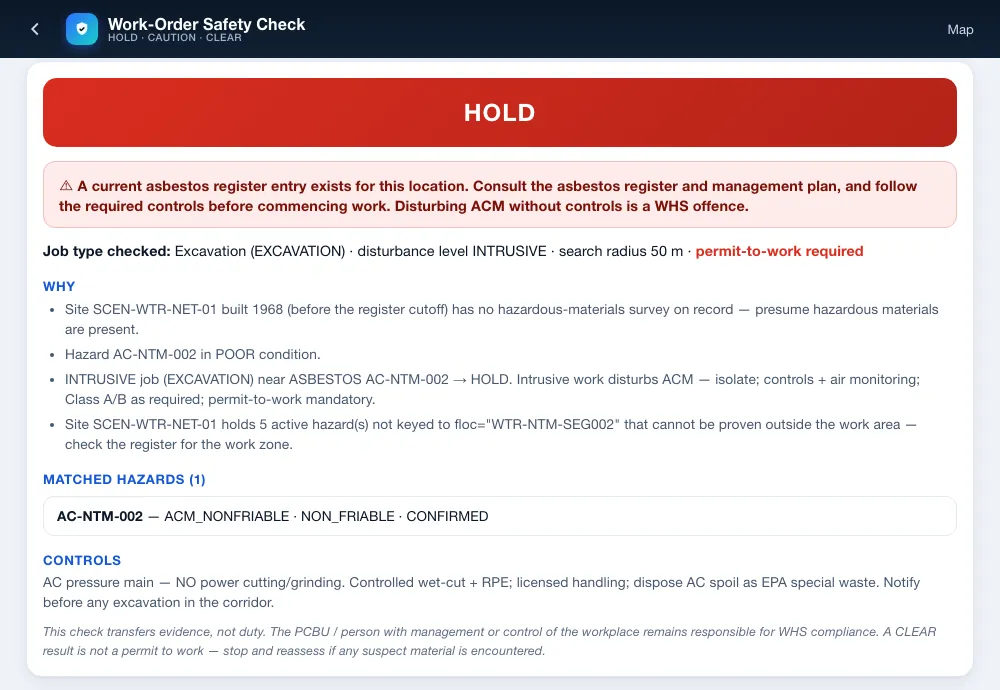
HazardIQ work-order safety check showing a red HOLD verdict for an excavation job on an asbestos-cement water main, with the reasons, the matched hazard AC-NTM-002 and the controls to follow.
Work-order check. An excavation over an asbestos-cement main returns HOLD, with the reasons and the controls.
hazardiq · hazard map · demo data
HazardIQ hazard map on an OpenStreetMap street map, with coloured markers for hazard occurrences by risk tier and a layers and legend panel on the left.
Hazard map. Occurrences plotted by risk tier, with layers for sites, hazards and survey coverage.
hazardiq · hazard register · demo data
HazardIQ hazard register: a list of fifteen occurrences with item reference, site, hazard type and material description, under filters for site, status, condition and risk tier.
Hazard register. Every occurrence by site, hazard type and material, filterable by condition and risk tier.
hazardiq · evidence check log · demo data
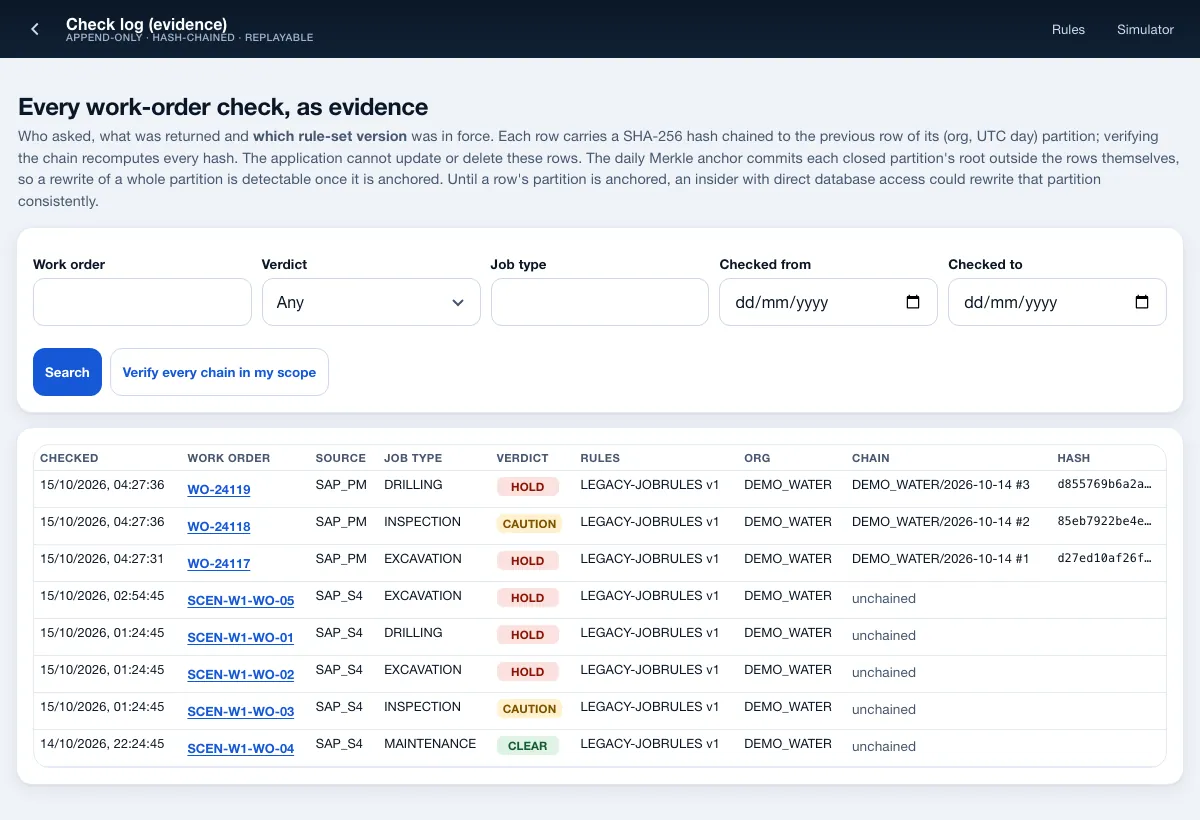
HazardIQ evidence check log: a table of work-order checks with HOLD, CAUTION and CLEAR verdicts, the rule version in force, the organisation, and a hash chained to the previous entry.
Evidence log. Every check recorded with its verdict, the rule version in force and a hash chained to the previous entry.
hazardiq · waste chain of custody · demo data
HazardIQ waste reconciliation: tiles counting consignments, clean, variance, in progress, receipt overdue and chain broken, above a table that balances two asbestos consignments from generated to collected, received and disposed.
Waste chain of custody. Each load balanced from generated to collected, received and disposed, with gaps flagged.
Where it fits

Not another EAM. The compliance layer on the one you have.

Maximo, SAP EAM, TechnologyOne, Hexagon and Esri are the system of record for your assets. HazardIQ is the hazardous-materials decision layer that sits on top — it reads your functional-location and equipment master, and hands your crews and planners a defensible verdict. It complements your EAM/GIS; it doesn’t replace it. It also runs standalone.

SAP EAM / PM→HazardIQ→Esri ArcGIS ·work order in, HOLD/CAUTION/CLEAR out, occurrence on the map.

The gap the platforms leave

EAMs track the asset. GIS shows where it is. Neither answers the question a supervisor has at 7am: is it safe to open this one, today, for this job? HazardIQ answers it — and records the evidence.

Integrate, don’t compete

Adapters for SAP S/4HANA PM/EAM, IBM Maximo and TechnologyOne are tested on recorded work-order data; a live check in your non-production system is part of every pilot.

For your role

Five people decide. Each gets their argument.

An EAM-compliance purchase is decided by a committee. Pick your seat — the pain, the capability and the evidence are written in your language.

What each role sees
Poster frame for the executives and officers role video: the title 'Due diligence you can show' beside the HazardIQ executive dashboard with register and work-order counts.

Executives & Officers

A live view of active register items, high-risk items, overdue reviews and work orders on HOLD, each backed by a record you can verify.

Poster frame for the WHS and compliance role video: the title 'Register, plan, reviews and proof' beside the HazardIQ statutory reporting screen.

WHS & Compliance

The statutory register, management plan and regulator visit pack, generated from live data, with every check kept as evidence.

Poster frame for the asset and engineering managers role video: the title 'Know what you know, and what you don't' beside the HazardIQ hazard map.

Asset & Engineering Managers

Hazards, sites and survey coverage on one map, linked to your functional locations and equipment, so unknowns become a survey programme.

Poster frame for the maintenance planners role video: the title 'A verdict inside your EAM, before release' beside a HazardIQ work-order check showing HOLD.

Maintenance Planners · work management

Each work order returns HOLD, CAUTION or CLEAR in the system you already use, with the reason in plain words.

Poster frame for the EAM, GIS and IT leads role video: the title 'Integrate. Secure. Configure.' beside the HazardIQ form builder.

EAM, GIS & IT Leads

Adapters for SAP S/4HANA PM, Maximo and TechnologyOne, proven against recorded interfaces; your live connection is part of the pilot.

Poster frame for the environment and waste officers role video: the title 'Classify. Track. Reconcile.' beside the HazardIQ waste reconciliation screen.

Environment & Waste Officers

Each consignment linked to its removal job, transporter and receiving facility, with a mass balance and chain-of-custody gaps flagged.

Poster frame for the field crews and contractors role video: the title 'Know before you disturb' beside the HazardIQ on-call and critical alerts screen.

Field Crews & Contractors

A safety brief for the job: the hazards nearby, the controls, and who is on call.

The argument for each seat
END USER & CHAMPION · owns the daily reality

You inherited a hierarchy nobody fully trusts and an asbestos register that’s three surveys out of date. Every refurbishment starts with a scramble to find out what’s in the wall.

  • ✓The hazardous-materials register hangs off your functional-location hierarchy — occurrences roll up to sites and FL/EQ, versioned survey-by-survey so you always see the latest of N.
  • ✓A data-quality score you can see per site — so you know which parts of the register to trust before you plan against them.
  • ✓Condition, risk tier and next-review clocks maintained automatically — less spreadsheet archaeology, fewer surprises on site.
Ask for your hierarchy’s data-quality score →

Asset hierarchy · illustrative

▸ SITE · Riverside Depot DEPOT-01
▸ FL · Workshop A 2 managed
• Roof sheeting — ACM bonded · GOOD current
• Eaves lining — ACM bonded · POOR review due
▸ FL · Pump Hall 1 friable
• Pipe lagging — ACM friable · POOR HOLD
TECHNICAL EVALUATOR · owns integration & the data model

I’m the one who has to make it talk to SAP PM and the Esri feature services — without another bespoke integration that rots in eighteen months.

  • ✓Native SAP BTP — CAP (Node), XSUAA, HANA, single-tenant data isolation. Not a bolt-on hosted elsewhere and stitched back in.
  • ✓Reads your functional-location / equipment master over a BTP Destination (released S/4 OData); writes back only what you authorise. Geometry as GeoJSON, ready for an ArcGIS feature layer.
  • ✓Additive-only data model, quality dimensions aligned to ISO 8000-8, correlation-ID tracing, audit-log emission, SBOM. Boring where boring is a feature.
Ask for the reference architecture →

Integration & data model

SAP S/4 · API_FUNCTLOCATION / API_EQUIPMENTOData
▼ BTP Destination · read-through
HazardIQ · CAP · XSUAA · HANAregister + verdict
▼ GeoJSON feature
Esri ArcGIS · feature servicemap layer
RISK & STANDARDS GATE · owns defensibility

I can’t sign off on data I can’t measure, and I can’t defend a decision I can’t trace.

  • ✓Data quality scored on six dimensions aligned to ISO 8000-8 — completeness, validity, uniqueness, consistency, timeliness and a reference-conformance accuracy proxy — per register, with the offending records named.
  • ✓Line-of-sight aligned to ISO 55001 from policy to the work order; a tamper-evident field-level change log on every record — who changed what, when.
  • ✓Every verdict carries its evidence and the “evidence, not duty” notice. We flag, gate and measure — compliance stays with the duty-holder.
Ask for the conformance mapping →

Data-quality scorecard · illustrative

Completeness
94
Validity
98
Uniqueness
88
Consistency
96
Timeliness
71
Accuracy*
91

*proxy: reference-conformance + range plausibility. True accuracy needs a verified source. Synthetic demo data.

COMMERCIAL GATE · owns vendor risk

I’ve read a hundred capability statements that don’t survive contact with the evaluation matrix.

  • ✓Evidence built to your criteria, not to the brochure — security, data protection, standards alignment and integration, each with its status stated plainly (see the claim-status table).
  • ✓Testable claims: automated test suite, SBOM, audit log, org isolation — in a form you can drop into a response schedule.
  • ✓We say what is not done: no independent penetration test or IRAP assessment yet.
Ask for the capability evidence pack →

Criteria → evidence

SecurityXSUAA auth · org data-isolation · tamper-evident audit log · SBOM
Data prot.privacy statement · retention & legal-hold · data processing agreement in preparation
Standardsaligned to ISO 55001 · ISO 8000-8 quality dimensions (not certified)
IntegrationSAP BTP native · S/4 read-through · Esri GeoJSON
Deliveryautomated tests · CI gates · self-reported
ECONOMIC BUYER · owns the business case

I can’t approve spend on a maybe. Show me what I gain in control and evidence, against what it costs.

  • ✓Turns an unknown into a HOLD before a crew disturbs it — a documented control point between a routine work order and the work.
  • ✓Capital efficiency: a scored, current register lets you right-size remediation — manage-in-place vs blanket removal — and defend the call.
  • ✓A one-page business case built on your own figures, ready for the capital committee. We don’t ship generic savings numbers.
Ask for the one-page business case →

What the subscription covers

Your own figures
Any business case uses your incident history and your estate size — not ours.
Annual subscriptionquoted by estate size
Before-work gate on every jobincluded
Tamper-evident register and evidence trailincluded
Facts, not adjectives

What is built, stated plainly.

Platform
Native SAP BTP

CAP · XSUAA · HANA · single-tenant isolation

Standards
Aligned to ISO 55001 · ISO 8000-8

line-of-sight + six quality dimensions; not a certification

Security
Audit · SBOM · org-scope

tamper-evident change log, tested, fail-closed

Interop
SAP · Esri ready

S/4 read-through · GeoJSON feature layer

Every claim has a status. See what is tested, and what is not →

Architecture

Reads your master. Writes only what you allow.

HazardIQ sits beside your EAM and GIS, not in front of them. It read-through-merges your functional-location and equipment master, keeps the hazard occurrences and their verdicts, and publishes geometry your ArcGIS estate can consume. Additive-only, org-isolated, audit-logged end to end.

Architecture & security →

The next step

See it on a sample of your data.

A 45-minute working session: bring one site and one work order. We load a sample of your data into the register, score its data quality, and run a real HOLD / CAUTION / CLEAR check on it. Loading a full register is a separate, scoped step.

Book a working session